1. How DOGE Is Modernizing Government—And Why It Matters
In the May 21st episode of the All-In Podcast, Antonio Gracias shared updates on the Department of Government Efficiency (DOGE) and their efforts to cut waste and modernize federal systems. One example really resonated: tracking immigration fraud meant integrating siloed data across the Department of Labor, DOJ, Homeland Security, Medicaid, and even voter systems. No single view existed to follow a case from end to end.
DOGE is treating this as a software problem. They’re collaborating with Palantir to build a centralized “mega API” for IRS data and potentially other government systems. While privacy concerns remain, the vision is bold: real-time interoperability across federal agencies.
As a developer, I see the beauty in this approach. Imagine an architecture where government APIs can safely talk to each other—where AI can verify identity, eligibility, and risk dynamically. That’s not just modernization. That’s zero-defect governance.
🎧 Listen to the episode – All-In Podcast: May 21, 2025
2. The Real Tech Stack Behind Government AI
What struck me most was how Antonio Gracias described bugs in government systems the same way we describe bugs in code—small errors that cause huge trust issues. That analogy hit home. In software, we work hard to catch edge cases, validate logic, and build test suites. But in policy? A broken form or disconnected database can block someone from voting or getting healthcare.
Using AI to patch these gaps, streamline decisions, and create transparency feels urgent and powerful. It’s not just about automating forms—it’s about building reliable public infrastructure.
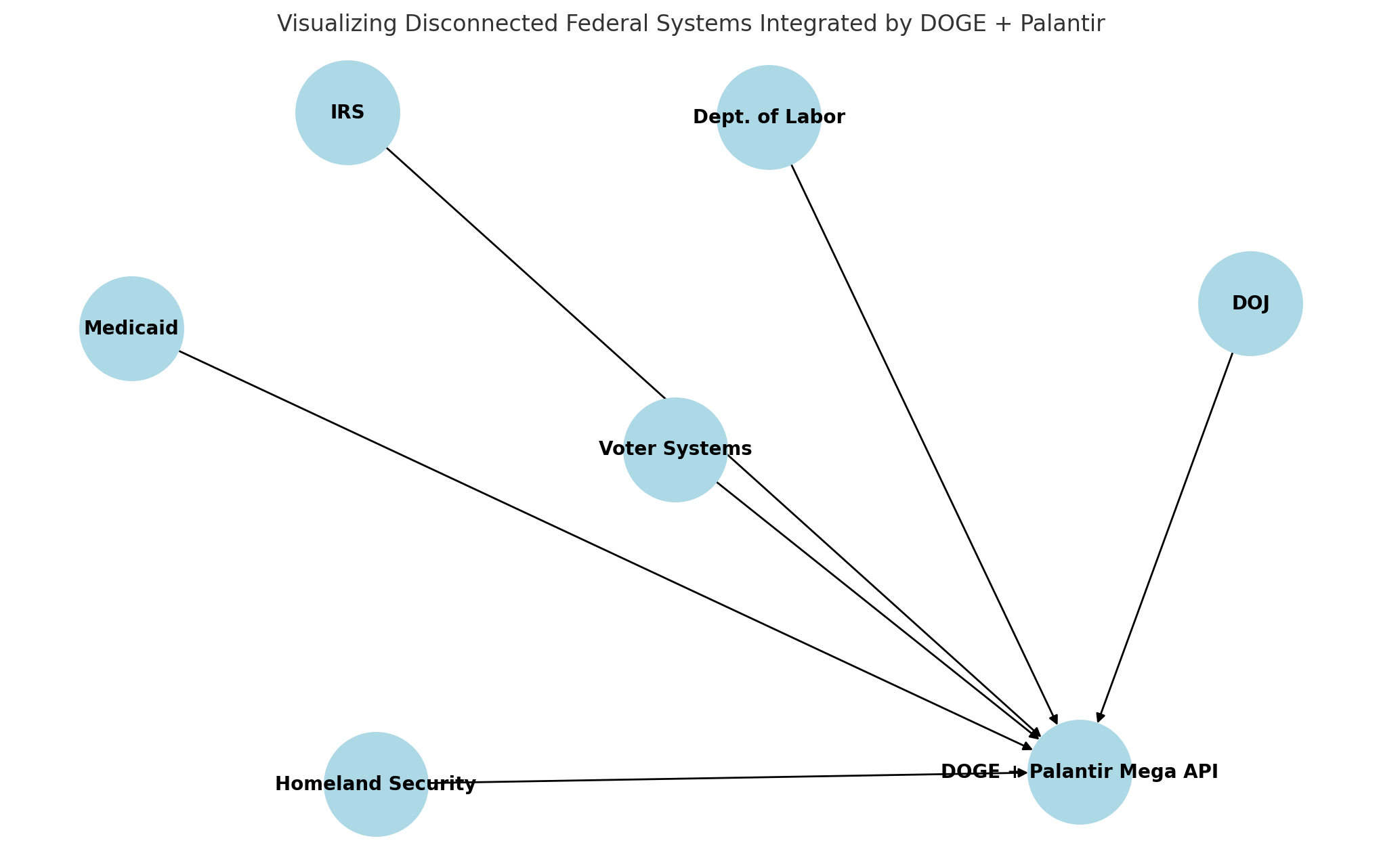
This diagram shows how disparate agencies like the Department of Labor, DOJ, Homeland Security, Medicaid, and Voter Systems all connect to a centralized “Mega API” facilitated by DOGE and Palantir. The goal: real-time, agentic AI-driven interoperability across the federal tech landscape. From what I can gather, DOGE’s collaboration with Palantir involves:
- Data unification through centralized APIs
- Real-time analytics to flag issues like fraud or identity mismatches
- Agentic AI to continuously monitor, validate, and recommend corrective actions
If done well, this system could transform case management, fraud detection, immigration processing—even voting verification. It reminds me of agentic patterns we use in software: real-time context management, layered permissions, and logic-driven outcomes.
4. Personal Reflections
As someone who’s worked in many branches of the federal government through contracting, this shift excites me. I’ve seen how fragmented these systems are. I’ve written glue code to connect databases that were never meant to speak to each other.
This isn’t just a technical upgrade. It’s a philosophical one: treating governance like a system we can debug.
The vision is clear. The tools are ready. And I hope we’re brave enough to keep building it.
 My experiments with AI
Leave a comment