The Contrast Between AI’s Exponential Speed and My Human Pace
From Human-in-the-Loop to Autonomous Agents
“If there’s less and less human interaction with AI, what are we humans left doing?”
Lately, I’ve been wrestling with a big question: can my human brain keep up with AI’s relentless pace?
As a developer building agentic AI systems, I’m right at the edge of innovation. The speed of progress in this space is unreal—new models drop almost daily, alongside frameworks, architectures, agentic tools, evaluation benchmarks, and protocols. It’s an avalanche of ideas and tech. On one hand, it’s exhilarating. I love diving into new tools, experimenting, and building applications that push boundaries. But on the other, it’s overwhelming. There’s no simple way to process it all. Even filtering what’s worth my time is a job in itself—sorting through the noise to find the signal.
Sundar Pichai’s words from a podcast really hit home:
“Sometimes when you jump in the ocean, it’s so choppy, but you go down one foot under, it’s the calmest thing in the entire universe.”
He talked about tuning out the noise to focus on the signals. I’m trying to get better at that, but man, it’s tough when the noise is so loud.
Right now, I’m the one leading the charge. I’m the driver. My AI agents do what I tell them—they don’t run on their own. That’s where the “human in the loop” comes in, not just as a failsafe but as the core intelligence guiding the process. When I don’t give clear instructions, the agent can start to wander, sometimes making stuff up. It’s not always hallucination; it’s more like it’s trying to be helpful but lacks context. That’s when I step in—correcting, verifying, adding specifics to steer it back on track. Each tweak makes the next output better, more grounded, closer to what I need.
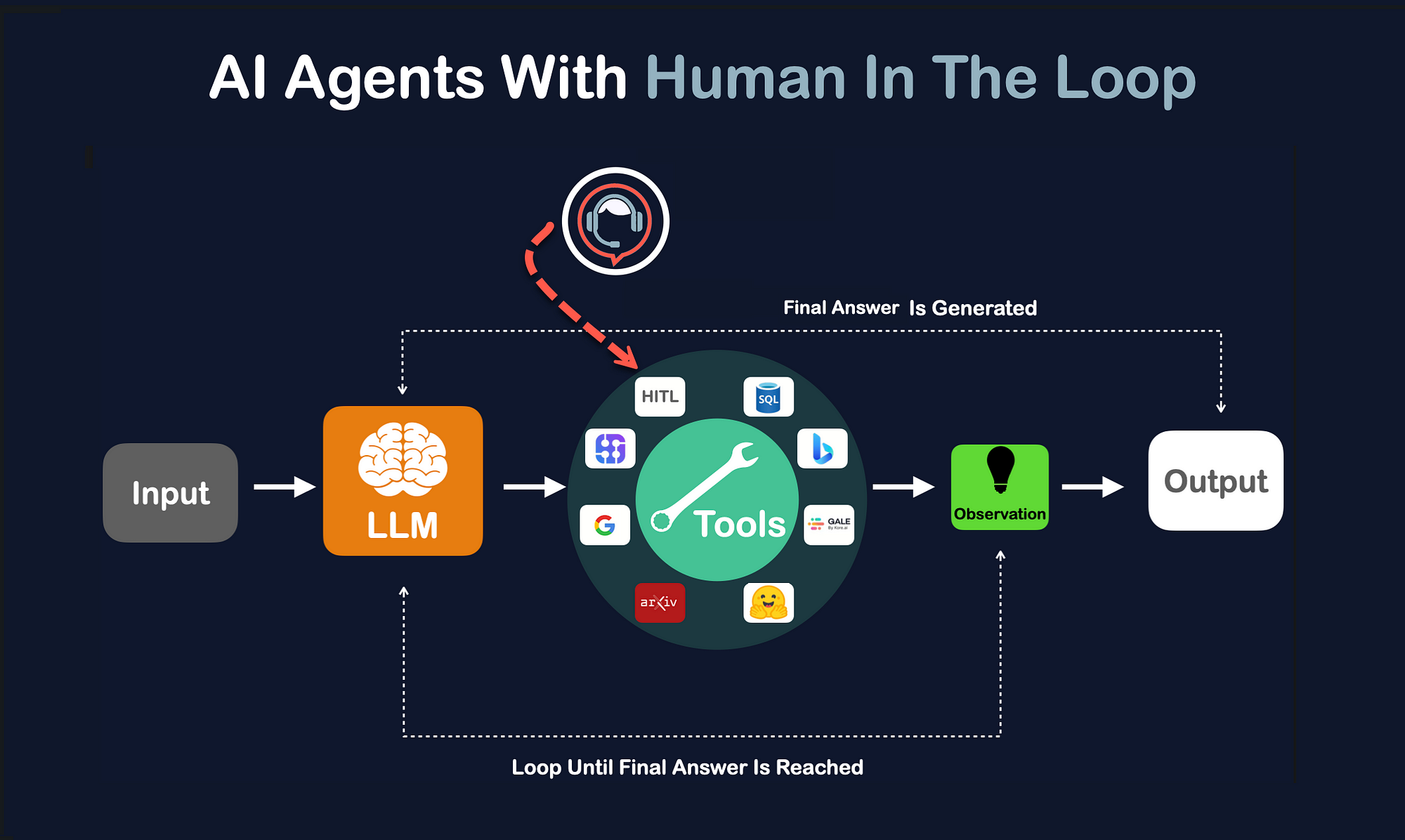
AI Agents With Human In The Loop (Image source: AI Agents With Human In The Loop)
It’s not a “press a button, get a perfect result” deal. It’s iterative, collaborative, and honestly, it depends on my energy. Some days, I’m in the zone, guiding the agent step-by-step because I know exactly what I want. Other days, it’s faster to just do it myself than to explain every detail. But the key is: I’m always involved. The agent gives me a starting point—a draft, a set of options—but I’m the one steering the ship.
What makes this manageable is how my AI agents summarize and explain their output. I can review everything because most tasks are complete in 20-30 minutes, tops. It’s digestible, practical, and keeps me in control.
But where’s this headed? That’s the bigger question. I’ve heard the latest Claude models can iterate and refine for seven hours straight without requiring human input. That’s a game-changer. If agents can run complex flows for hours, iterating on their own, what does that make me? A coach? A strategist? A curator of prompts and goals? Right now, I’m neck-deep in the process—reading every output, tweaking logic, guiding the flow. But if agents start handling that themselves, will I still be in the loop the same way?
As Sundar Pitchai points out
“there will be a point when AI systems are able to interpret, understand, interact with the human world to sufficient degree to where many of the manually controlled human in the loop systems we rely on become fully autonomous.”
It’s not fear—it’s a shift. A real shift in how I see my role. Today, I’m the driver. Tomorrow, maybe I’m the architect of systems that drive themselves. That’s thrilling but also a little unsettling. There’s something so human about debugging, reasoning, making those small choices. If that fades, what kind of builder will I become?
An Enhanced Mind
My brain is buzzing with ideas—not just for work but for life. Things that once felt out of reach now seem doable. Take this week: I’m planning a graduation party for my son, Philip, and wanted creative party favors. I thought an activity sheet would be fun since he loves them. So, I started designing one—a word puzzle and a maze based on Philip’s ideas. Then Charlotte suggested a color-by-number sheet. With a little AI help, pulling it all together was so easy. It’s not just about saving time; it’s about unlocking creativity in unexpected ways.
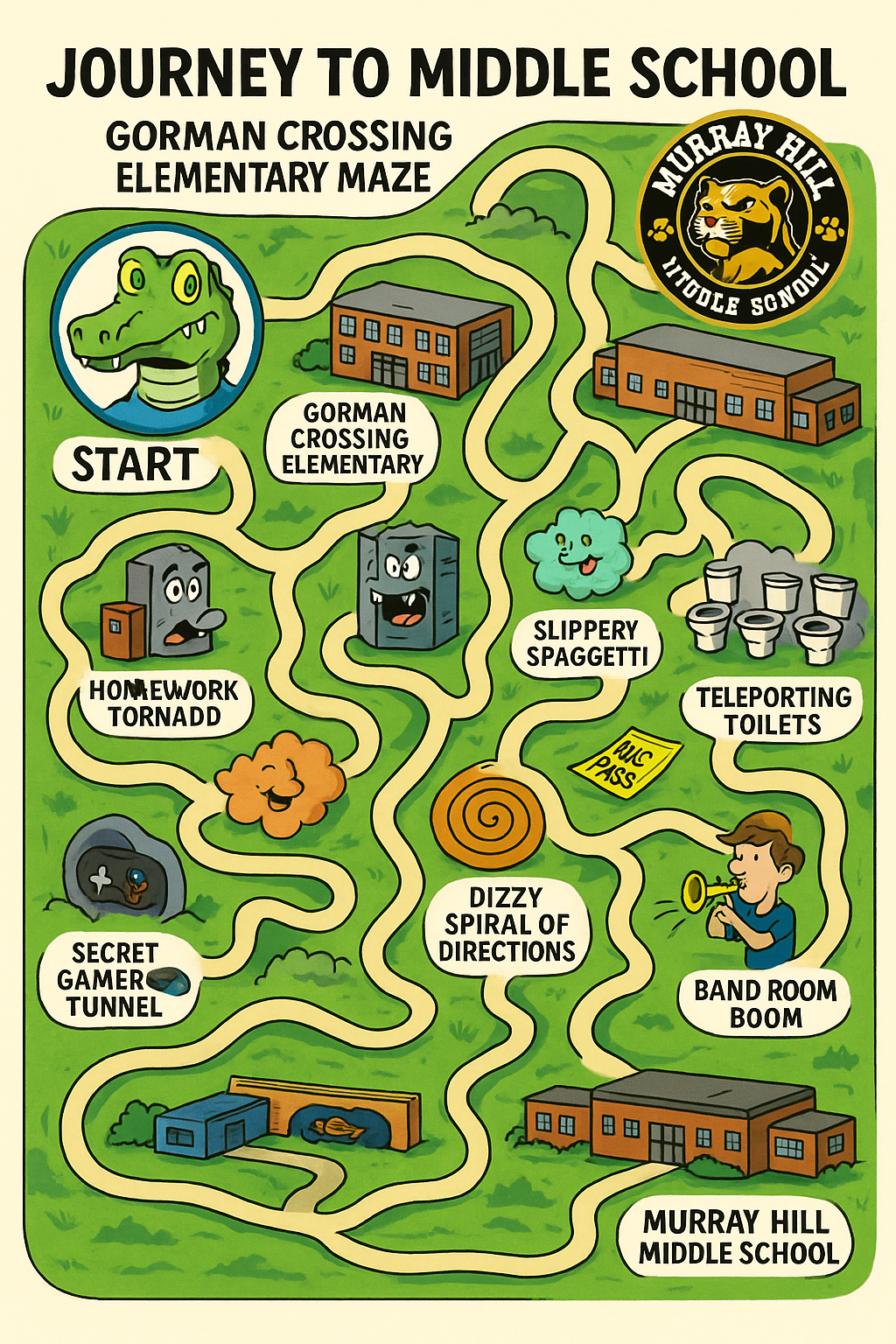
I even tried my hand at teaching, something I never thought I’d be good at. Using AI, I built a computer science curriculum for kids, complete with quizzes and question sheets aligned with CSTA standards. ChatGPT walked me through setting it up on Google Classroom, and it’s been amazing to see the kids get excited about coding.
That’s what blows my mind. With the right tools, my human brain feels enhanced. Ideas keep sparking. Projects I never thought I could tackle suddenly feel within reach. The tools aren’t doing it all—they’re meeting me where I am, sparking momentum, opening doors.
So, can the human mind keep up with AI? For me, the answer today is yes—but only because I’m staying curious, learning, and building. My brain isn’t moving at AI speed, but it’s growing, stretching, evolving. These tools are powerful enough to amplify my ideas and take me further than I ever thought possible.
 My experiments with AI
Leave a comment