🚀 Why This Moment Matters
We are finally entering a season of bold decisions.
As someone building AI agents on the front lines, I’m thrilled to see the AI Action Plan prioritize speed, experimentation, and infrastructure. Innovation has been throttled by unnecessary friction — not just from software bureaucracy, but from foundational systems like energy and compute infrastructure. What’s finally happening feels like someone lifted the weight.
🔥 Energy is the Real Accelerator
Before we could embrace nuclear again, we had to let go of the fear that stalled it. During the Obama administration, several nuclear plants were shut down — not because they failed, but because of post-Fukushima anxiety. The 2011 disaster in Japan reignited public concern over safety, triggering extensive reviews and stricter regulations in the U.S. (Wikipedia, San Onofre Closure). Combined with economic pressure from cheap natural gas, aging infrastructure, and prolonged permitting delays, many plants (like San Onofre and Vermont Yankee) were retired early.
Today’s policies finally pivot away from that hesitation. It’s not nostalgia — it’s necessity. Nuclear is clean, powerful, and now essential to scale up AI-era infrastructure at the pace we need. Jason Calacanis nailed it:
“You can’t win the AI race without energy, and we don’t have it scaled yet. That’s the bottleneck.”
China is adding 400+ gigawatts of energy capacity, while the U.S. manages only several dozen — creating a massive gap that threatens AI leadership. Michael Kratsios warned that AI will need 50+ gigawatts by 2028, more than twice New York City’s peak demand. Meanwhile, China’s AI-driven EVs, like BYD’s cars with suspension systems scanning roads 1,000 times per second, show how their energy and tech investments are already paying off.
One of the most exciting parts of the plan? The full embrace of dispatchable energy — including natural gas, nuclear, and yes, even coal — to fuel the next wave of compute. We’re talking about thousands of new data centers that need real-time, stable, scalable power. Wind and solar alone won’t cut it for the latency and load AI requires.
It’s refreshing — no, exhilarating — to see policy that doesn’t shrink from the future, but leans into it with ambition. We’re no longer whispering about possibilities. We’re building them.
🎙️ What the All-In Podcast Got Right
Over five episodes, the All-In crew laid out the playbook — not just with speculation, but with voices that matter: Michael Kratsios. Jensen Huang. Lisa Su. JD Vance. Shyam Sankar. Trump himself.
“If we try to regulate this stuff out of existence, we will lose the future to China. We have the best AI in the world. Why would we shackle it with bureaucratic red tape?” — JD Vance, U.S. Senator (Part 3 @32m45s)
Michael Kratsios, former U.S. CTO, laid out these three pillars in his remarks on the All-In Podcast (Part 1). He emphasized that “the number one factor that will define whether the United States or China wins this race is whose technology is most broadly adopted in the rest of the world.” That geopolitical framing was echoed by Microsoft’s Brad Smith, who argued that setting global norms was just as important as local innovation.
🧭 The AI Action Plan — At a Glance
| Pillar | What It Unlocks |
|---|---|
| 1. Accelerate Innovation | Regulatory rollback, support for open-source, R&D testbeds, sandbox environments |
| 2. Build Infrastructure | Data centers, semiconductor supply chains, fossil and nuclear energy restoration |
| 3. Lead Globally | Promote U.S. AI exports, international standards aligned with democratic values |
Reference: AI.gov Action Plan | WilmerHale Summary
Jacob Helberg, co-founder of the Hill & Valley Forum, framed the AI race as a “fast-paced competition to define the future of civilization itself,” highlighting the urgent need for public-private partnerships to bridge Silicon Valley and Washington.
David Friedberg added that AI-driven manufacturing could create “high-quality jobs” by blending software and hardware talent — reinforcing Chris Power’s vision of using AI to reskill American workers and rebuild the industrial core.
The message was clear:
“America has the talent, capital, and innovation. What we’ve lacked is the courage to act at scale.” — paraphrased from All-In: Winning the AI Race, Part 1
Full Series:
- Part 1: The AI Race Begins
- Part 2: Infrastructure and Jobs
- Part 3: Global Leadership
- Part 4: Policy and Innovation
- Part 5: The Future of AI
🛠️ Chris Power’s Wake-Up Call: America’s Industrial Decay
“We’re in a global race.”
— Chris Power, CEO of Hadrian (All-In, Part 1 @18m46s)
That’s how Chris Power frames it. And it’s not hyperbole.
The U.S. didn’t just fall behind in software. We chose to deindustrialize. In Power’s words, starting with Nixon and the WTO, we hollowed out the middle of America and outsourced the backbone of our nation’s strength — manufacturing. While we were optimizing for margin, China was optimizing for sovereignty.
“While China de-industrialized us, they industrialized themselves and they treated manufacturing not as economics but a national security priority.”
We’re not talking hypotheticals. We’re talking hard, quantifiable gaps.
“We can’t produce enough missiles fast enough. If a major conflict were to break out today, we would run out of precision munitions in weeks — not months. China, on the other hand, can scale production exponentially faster.”This part made me pause. We’re good at building LLMs and launching apps. But China’s building factories — factories that produce 1000 munitions per year, while we run out of missiles within 7 days of conflict simulations and take 3 years to replenish.
Let that sink in.
“We produced a grand total of five ships last year. China? 1,784. That’s 200x more.”
Chris Power laid it bare: while we perfected software, we offshored our ability to build.
His point: America has lost the muscle that wins real wars.
📉 The Numbers Tell a Brutal Story
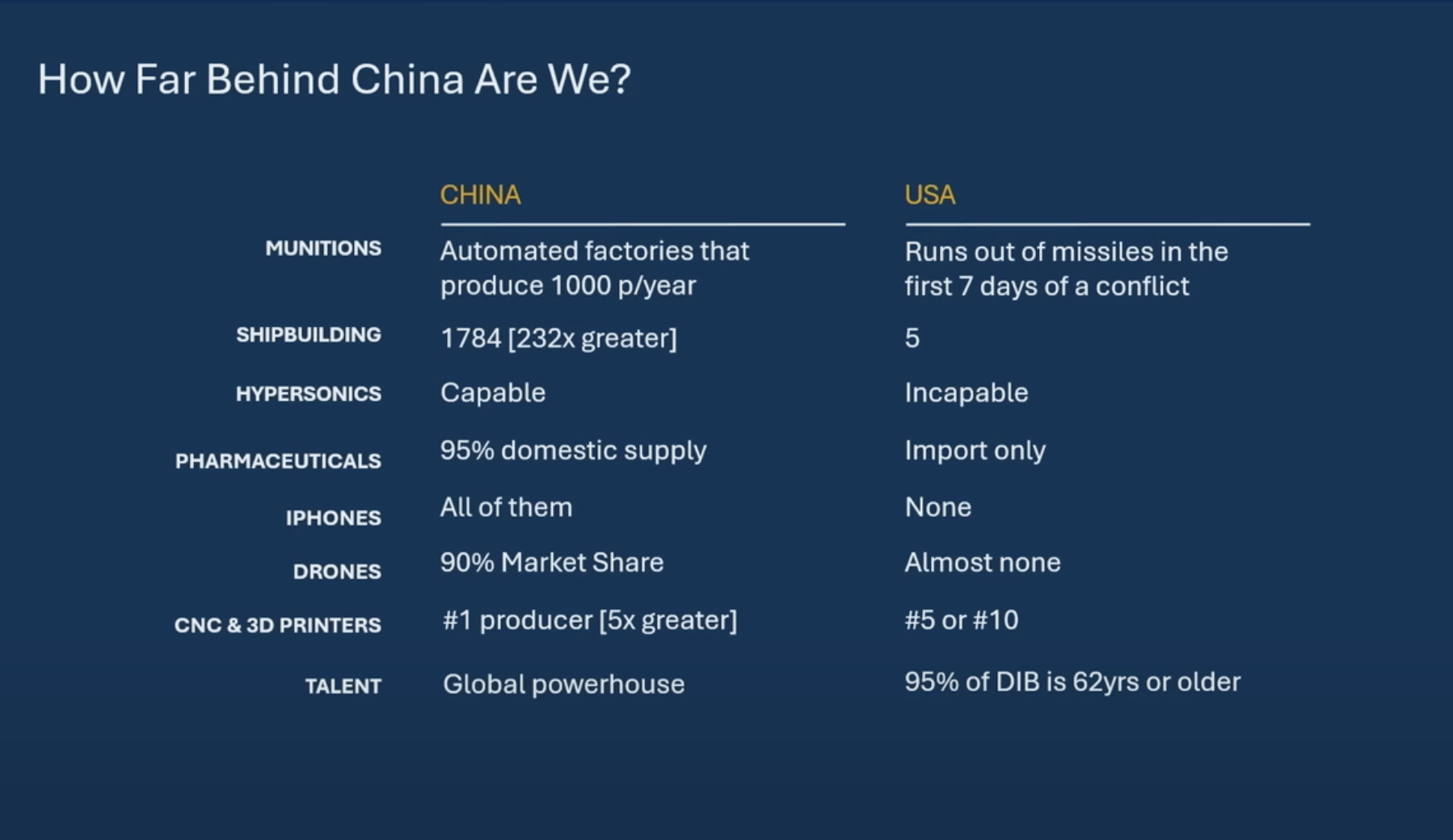
“Give me a billion dollars and we can’t hire enough welders or machinists anymore.”
He goes on to compare:
- 🇨🇳 China: Hundreds of defense-grade machine shops distributed and scaled nationally
- 🇺🇸 U.S.: A highly fragmented, outdated supply chain with <50 high-end facilities that take years to retool
Power’s wake-up call goes beyond munitions and ships:
“Pharmaceuticals are all offshore. Drones, iPhones, we don’t make any of them. And bear in mind in pharmaceuticals the CCP makes all our antibiotics.”.
He also highlighted the talent gap: “While the US is still the global powerhouse in software and AI talent, we made China into the global powerhouse for manufacturing talent.” (21m21s)
What hit me hardest was how this lack of domestic production capacity and skilled workers is a silent vulnerability. You don’t feel it until it’s too late. AI isn’t just about software agents and chatbots — it’s about command, control, compute, and combat.
🌱 AI Boom Meets Industrial Resurgence
“As AI goes through manufacturing, you’ll create millions of jobs… and that will allow us to reshore more commercial volume, not just in defense.” — Chris Power
This connects perfectly to my AI Boom Use Case Journal. Power’s vision isn’t just about defense. It’s about new AI-native jobs, reskilling Americans, and bringing meaningful tech jobs to middle America.
His team upskilled people from Home Depot and paralegal desk jobs into operators of precision machines and AI-informed factory managers. Some even became software engineers. That’s the kind of transformation I believe in.
“100% of our people never set foot in a factory before… We promoted many into leadership and engineering. That’s the American spirit plus AI.”
We’re not replacing people — we’re unlocking potential. This is how AI creates abundance — not by removing labor, but by redefining what valuable labor looks like. This is the AI Boom we should all be building toward.
🏗️ Hadrian’s Factory Push
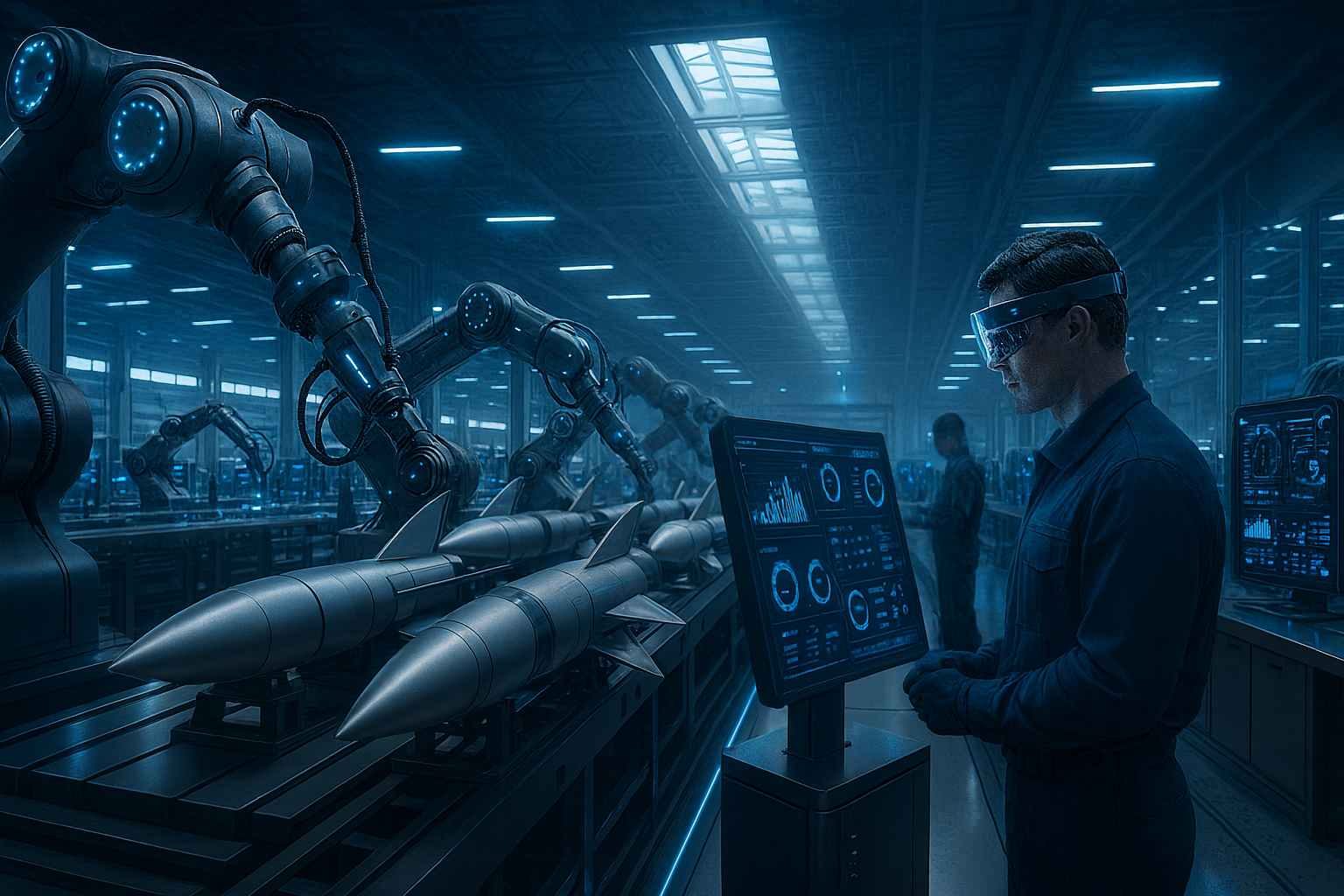
Hadrian’s operational throughput — Produces ~10,000 defense components per month, with automation allowing up to 10× faster output than traditional machinists
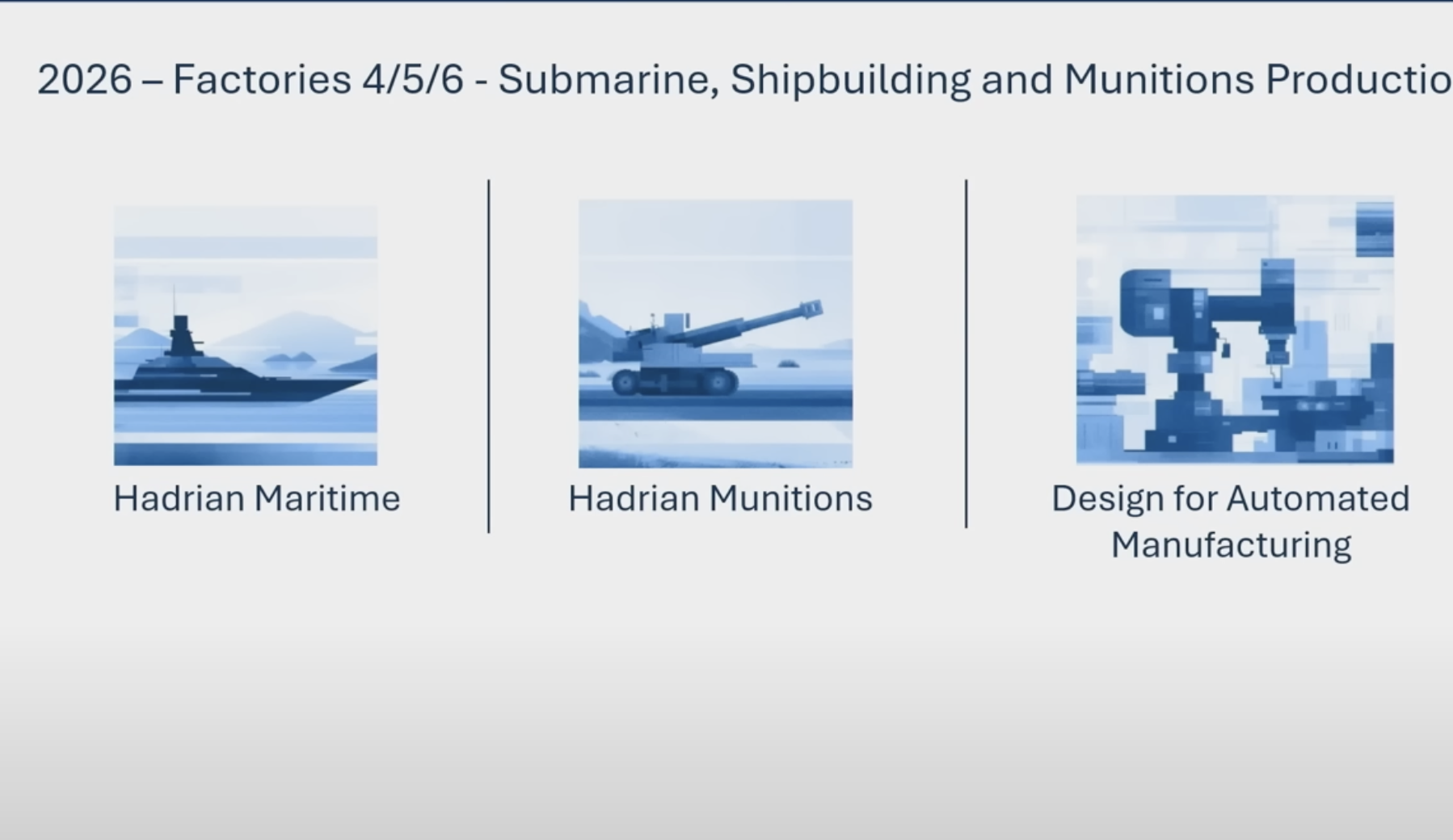
By 2026, Hadrian is launching:
- Factory 4 – Submarine & Shipbuilding
- Factory 5 – Automated Munitions
- Factory 6 – Design for Automated Manufacturing
U.S. Advanced Factory Footprint by 2045
One slide hit me hard: 2045.
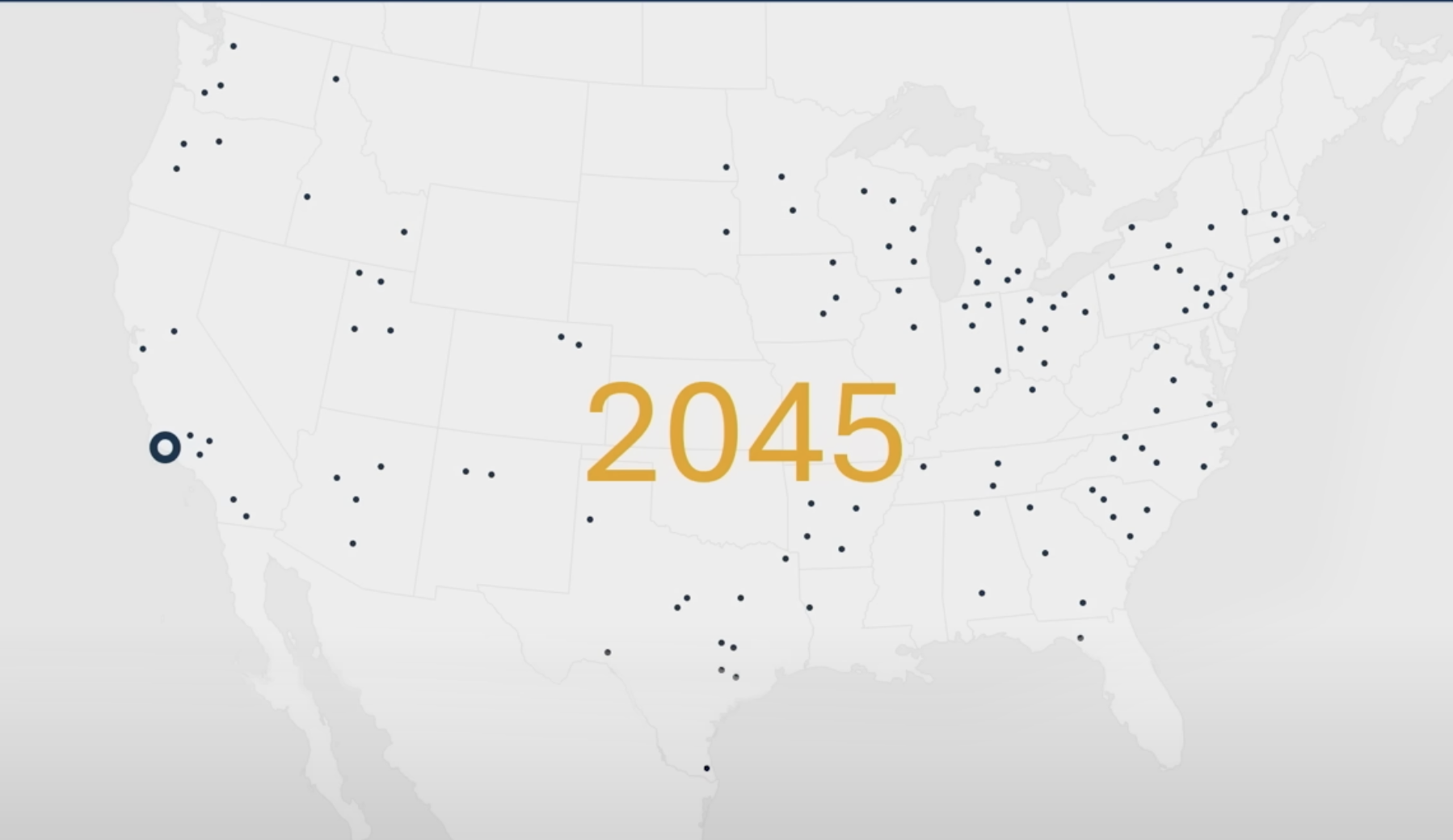
That’s how long it might take to fully rebuild U.S. industrial capacity at scale. Dozens of advanced factories distributed nationwide. Thousands of skilled workers. A nuclear-powered grid. It’s necessary — but daunting. As Chris Power noted:
“If you look at ship building or any of these other industries, we are begging for millions and millions of welders or machinists… you could give me a billion dollars and we can’t hire them in this country anymore because we lost that skill.” — All-In, Part 1
China’s current lead in manufacturing talent and infrastructure makes this timeline feel like a race against time.
Yet, there’s a faster track. Michael Kratsios emphasized that the AI Action Plan’s policies — deregulation, infrastructure, and global leadership — can be executed within 6–12 months, leveraging existing authorities.
“We don’t need new legislation to do this. The President can act now under current authority.” — All-In, Part 1
This urgency contrasts with the long-term industrial rebuild, showing how AI policy can accelerate progress now.
Jacob Helberg highlighted public-private partnerships, like the Hill & Valley Forum’s summit, as key to bridging Silicon Valley and Washington to drive this effort. Hadrian’s AI-powered factories are a start, training workers from non-traditional backgrounds into precision machinists and engineers.
“We hired folks from Home Depot. Now they run 10 machines and are getting promoted into software roles.” — Chris Power
Kelly Loeffler noted that 60% of SBA loans go to businesses with 1–5 employees, which created 720,000 jobs this year alone. These small businesses, paired with AI, can accelerate the industrial resurgence.
Can we afford to wait that long? It’s way further than what Sam Altman predicted with the Gentle Singularity
Let’s move like the future depends on it. Because it does.
“Every great nation is built on industrial power. Let’s remember how to build.”
 My experiments with AI
Leave a comment