AI in Education: When Students Lead and Schools Certify
A vision of student-led learning with AI: schools that nurture invention, support community projects, and certify the ability to solve real problems.
What this post covers
- The current debate opens a bigger question
- Curiosity becomes a path into expertise
- Learning to innovate with AI
- Schools challenge students to improve the world around them
- Small contributions can build the confidence to try more
- The exam changes with the work
- Certifications become more specific
- What makes this future worth pursuing
The future of education I imagine goes much further than giving every student an AI tutor to help with homework.
I imagine students choosing questions they care about, using AI to explore them, and following that curiosity into increasingly demanding work. A student could move from an interest in how something works to building it, testing it, and developing genuine expertise in a particular area.
Schools would evolve around that possibility. They would provide mentors, laboratories, workshops, collaborators, and controlled environments where students demonstrate what they can do. Exams and certifications would evolve too, measuring the complexity of the work students can accomplish with AI and the judgment they bring to it.
That is the possibility I want to explore: learning directed by the student, with schools providing the opportunities and standards that make achievement meaningful. I believe a key distinction in that future will be innovative ability: how well someone can use AI to imagine, develop, and build something worth creating.
The current debate opens a bigger question
Reading Stanford's review of AI in K–12 education and the All-In discussion about New York's restrictions made me think about what we are preparing students for.
Stanford's March 2026 summary identified 20 high-quality causal studies among more than 800 papers reviewed. Results suggest that assisted performance can improve while independent learning outcomes remain mixed. The evidence is early and depends on how tools are designed and used. Stanford SCALE review
That matters. We need to know whether students understand their work. But I also think we need a broader question: what should an educated person be able to accomplish in a world where AI is a normal working companion?
Testing what students can do without assistance still has a place. It tells us something about the understanding they bring to the interaction. I would also want education to develop their ability to investigate difficult questions and accomplish increasingly sophisticated work with the tools available to them.
The vision that follows is a proposal for that future. Today's studies test parts of it; they do not yet establish that this entire model works.
Curiosity becomes a path into expertise
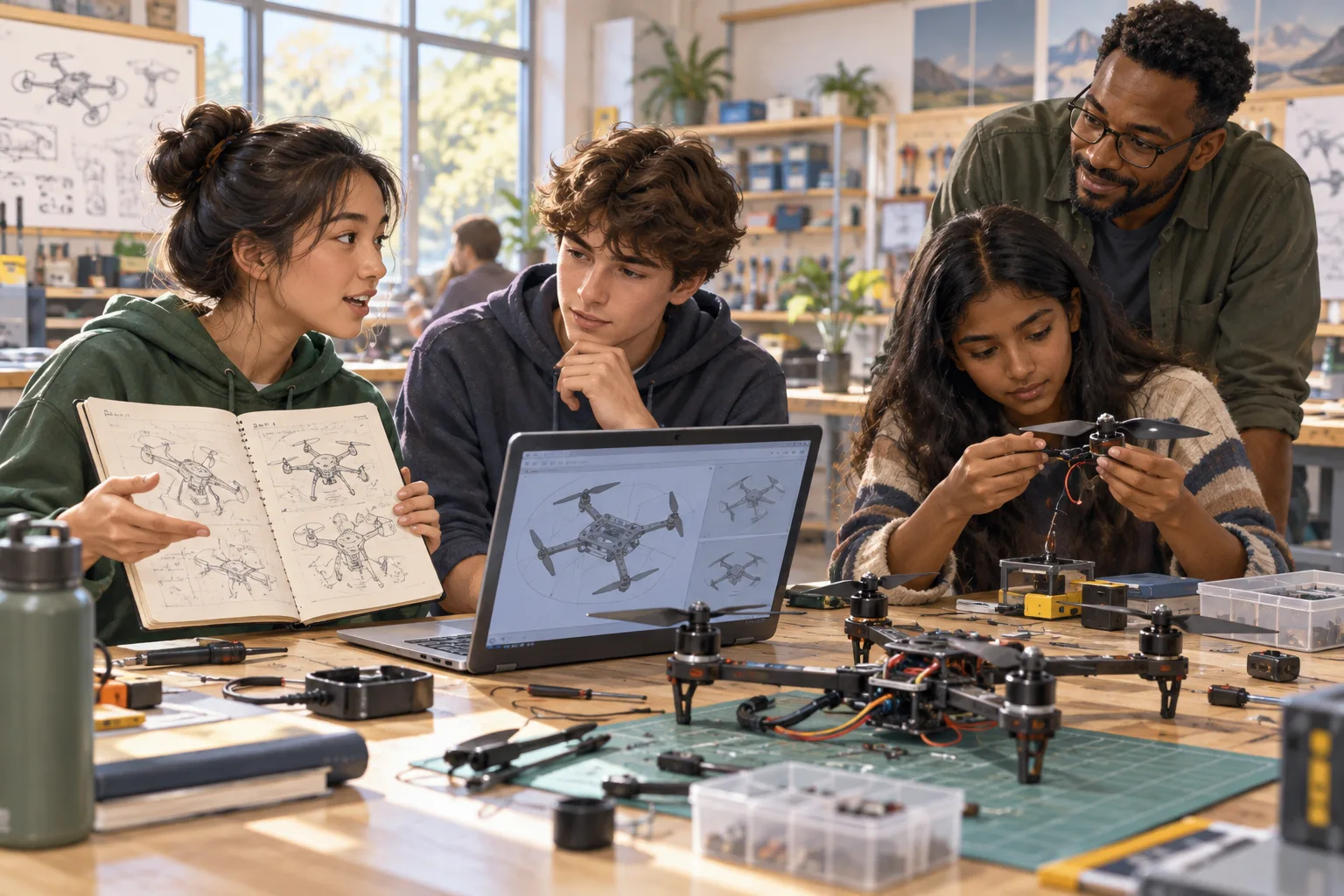
Imagine a student fascinated by drones.
Their first question might be simple: how does a drone stay in the air? With an AI companion, that question could lead into forces, motors, control systems, programming, and battery design. The student could ask for an explanation, build a simulation, discover a gap in their mathematics, and work through it because it now serves a purpose they understand.
As the work becomes more demanding, the AI could help organize a learning path, suggest exercises, challenge assumptions, and identify topics that need further study. A mentor would help the student distinguish a useful direction from an attractive distraction.
The student would decide what to pursue next, with increasing responsibility for planning and evaluating their progress. They might ask the AI to challenge a design, compare competing explanations, or help them prepare for a conversation with an expert. Learning to ask better questions would become part of learning the subject.
Eventually, the student might attempt a defined engineering challenge: build a small drone that carries a specified load through a controlled course within a power budget.
That project creates reasons to learn across subjects. Mathematics helps explain performance. Writing makes the design understandable. Experimentation reveals whether an idea survives contact with the physical world.
I can imagine similar paths beginning with music, history, agriculture, architecture, or a question about the student's own community. Interest provides an entry point, and each increasingly difficult task creates a reason to go deeper.
Reaching expert-level work would still take sustained practice, criticism, and experience. The exciting possibility is that more students could find a path into that work earlier, with help available when they encounter something they do not yet understand.
Learning to innovate with AI
Expertise gives students a foundation for creating something new. I would want education to deliberately develop that next step: noticing an unmet need, imagining different responses, and turning a promising idea into something that works.
Prompting would become part of that creative practice. Students would learn to give AI meaningful context, ask it to challenge assumptions, draw connections across subjects, and explore genuinely different approaches. They would then question its suggestions, bring in their own observations, and refine the direction through experiments.
For the student interested in drones, the starting point might be a conversation with a gardener who struggles to inspect plants on a steep slope. An exploratory prompt could be:
Help me explore ways to inspect plants on a steep slope with a small budget. Compare aerial, ground-based, and fixed-camera approaches. Draw on ideas from other fields, identify assumptions we should question, and propose a simple experiment for each approach. Explain what we would need to investigate before claiming an idea is new or useful.
The student could follow up with photographs, measurements, and feedback from the gardener. They might discover that their original drone idea is less useful than another design, or identify a particular problem that existing options handle poorly. The learning would include deciding which ideas deserve further work and when to change direction.
I would teach students to move through that whole process: explore possibilities, investigate what already exists, build a small prototype, test it with people, and improve it. An AI-generated suggestion would be a starting point for investigation. Evidence from the student's work would establish whether it offers an improvement.
If powerful AI becomes widely available, I expect the ability to find worthwhile problems and develop useful, original responses to become a major source of distinction. Education should give every student opportunities to practice that ability, including students who do not initially see themselves as inventors or entrepreneurs.
Schools challenge students to improve the world around them
In this future, I see schools taking on more of the practical character of trade schools, studios, and teaching laboratories.
Students would come to use equipment they cannot access at home, work with other people, receive expert critique, and demonstrate their abilities. Teachers would help shape projects, introduce unfamiliar ideas, diagnose gaps, and raise the standard of the work.
I would want schools to continually challenge students to become better problem solvers, starting with ordinary life. Notice something at home or in the neighbourhood that could work better. Talk to the people affected. Understand why the problem persists, then imagine a useful improvement.
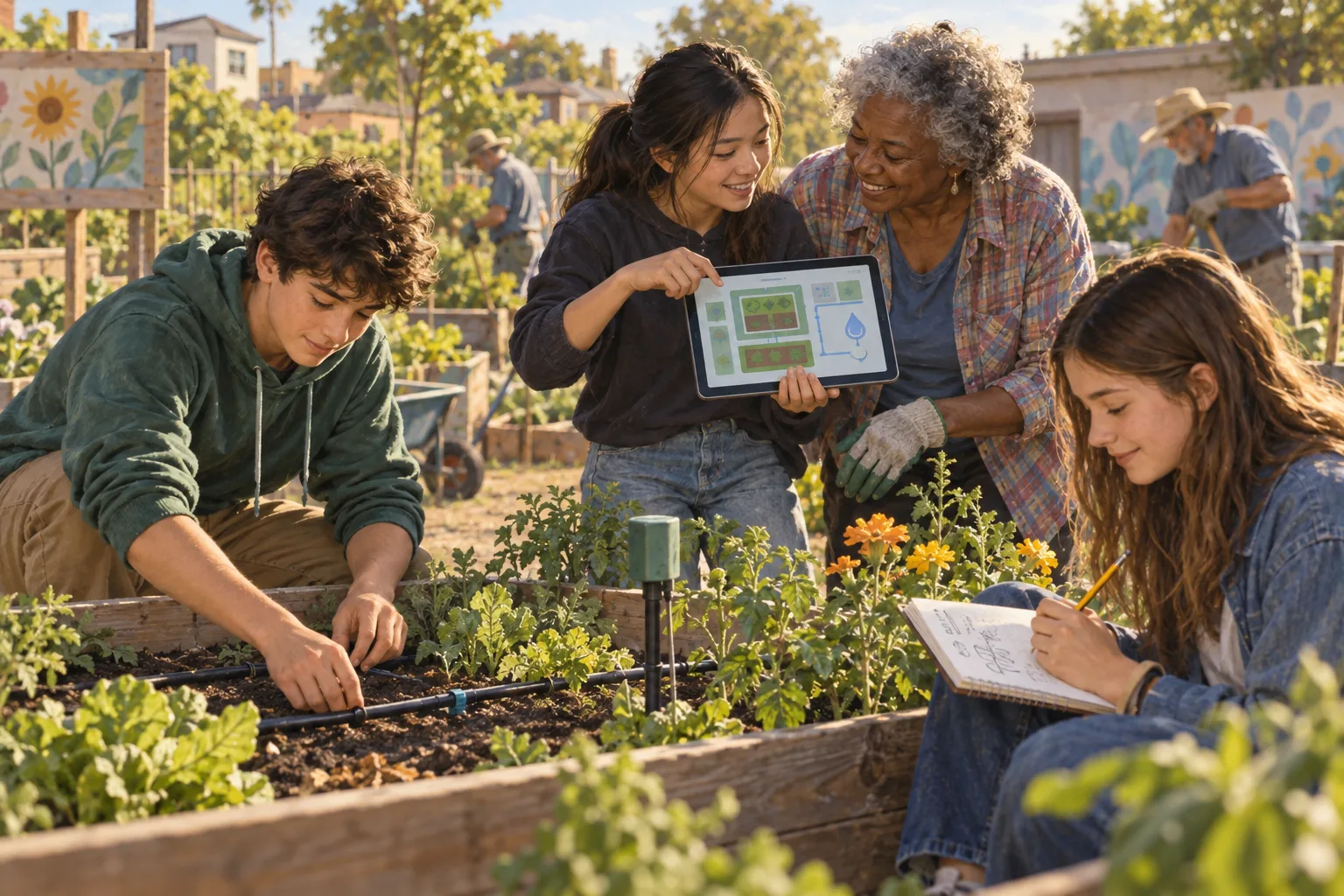
The starting point could be food going to waste at home, confusing recycling instructions, or a community garden whose volunteers struggle to coordinate watering. These are approachable problems with people students can listen to and results they can observe.
For the garden, students might first discover how volunteers currently organize the work. They could use AI to explore options, then build and try a simple scheduling system. The school would provide encouragement, materials, technical help, and introductions to people who could challenge the design. Teachers could keep raising useful questions: can someone new understand it? What happens when a volunteer misses a day? Could it work with fewer resources?
The school would support the project from that first observation through research, design, building, testing, and actual use. Students would learn to respond to feedback, document their work, and arrange a handover so that someone can keep using what they built.
Publishing would be part of completing the project. A school exhibition or student project page could explain the problem, show the solution, credit collaborators and AI assistance, and share instructions or materials others could adapt. Students would leave with a visible contribution to their community and a record of how they made it.
A student could arrive with an ambitious design developed through independent exploration. The school's contribution would be to help them test it against reality: materials, budgets, conflicting requirements, other people's needs, and the consequences of getting something wrong.
The same principle applies beyond technical trades. A history student could defend an interpretation against conflicting primary sources. A musician could compose, perform, and revise a piece. A student interested in local government could develop a proposal and answer questions from people affected by it.
Schools would also preserve a broad common education. Students need opportunities to discover interests they do not already have, and to encounter ideas beyond the recommendations of a personalized system. Independence would develop gradually, with more structure for younger learners and those who need it.
Small contributions can build the confidence to try more
The part of this vision that matters most to me is a young person seeing that their work helped someone. A neighbour uses what they built. A volunteer explains how their idea made a task easier. A classmate adapts their project to solve a similar problem.
I would want teachers to make those moments visible and give specific encouragement: you listened carefully, found a problem worth solving, stayed with a difficult revision, and made something useful. When an experiment fails, they could recognize what the student discovered and help them choose the next step.
That is the cycle I would want schools to nurture: notice a problem, build something, learn from the response, contribute, and take on a more demanding challenge. My hope is that repeated experiences of useful work and thoughtful encouragement help students develop the confidence to initiate projects themselves.
Success could begin with a small improvement that matters to one household. Each project would offer another opportunity to experience being capable of making a difference, with support available when the work gets difficult.
The exam changes with the work
If students learn and work with AI, I would expect many assessments to allow it explicitly.
The assessment could begin with an unfamiliar task, approved tools, a fixed amount of time, and clear constraints. Students would use AI as part of their process, while assessors observe the decisions they make and examine the resulting work.
Everyone taking that assessment would have access to comparable tools. The record would show what the AI contributed, what the student accepted or changed, and how the result was tested. An assessor could introduce a plausible but faulty recommendation and ask the student to evaluate it. That would make the quality of their judgment visible.
For the drone project, an assessor might change the payload or introduce a sensor fault. The student would need to investigate, adapt the design, and explain why the proposed correction should work. Producing an impressive design in advance would be only part of the evidence.
The rubric I imagine would look something like this:
| Capability | What the student would demonstrate |
|---|---|
| Framing the problem | Define a useful goal, constraints, and criteria for success. |
| Generating possibilities | Use exploratory prompts, observations, and connections across subjects to develop distinct approaches. |
| Innovating | Investigate existing solutions, develop an original contribution or useful improvement, and test its value. |
| Applying knowledge | Use relevant concepts and explain how they affect the result. |
| Working with AI | Delegate useful tasks, provide context, and decide when to intervene. |
| Verifying results | Check claims, test outputs, and identify errors or unsupported assumptions. |
| Exercising judgment | Compare alternatives and defend choices under real constraints. |
| Adapting | Respond to unfamiliar conditions, failed tests, or changed requirements. |
| Delivering | Produce something that meets a defined standard and can be used or examined by others. |
| Contributing | Work with the people affected, evaluate usefulness, and publish or hand over the work so others can benefit. |
| Communicating | Explain the work, acknowledge assistance, and respond to questions. |
Foundational understanding would show up in the decisions students make. Someone who cannot recognize an implausible result or explain a critical choice has a gap that a polished final product should not conceal.
Short oral defenses and selected independent exercises could help locate those gaps. The overall assessment would measure the student's ability to direct, evaluate, and take responsibility for work completed with AI.
Innovation would also need an open-ended assessment. Students could identify a problem themselves and present the alternatives they explored, the prompts and experiments that shaped their thinking, and what changed after testing. I would assess originality relative to their level and the existing work they investigated, along with usefulness and the quality of their evidence. A thoughtful experiment that rules out an idea can demonstrate stronger judgment than a polished prototype whose claims have never been tested.
Certifications become more specific
A useful credential in this environment would describe what someone has demonstrated, under which conditions, and to what standard.
For example, a student might demonstrate the ability to design, build, test, and defend a small autonomous system with specified tools and supervision. More demanding demonstrations could establish readiness for a broader range of work.
A portfolio would show the development of the work. Controlled assessments would establish that the student can perform when the problem changes. Independent assessors and consistent standards would make the result more credible than an AI tutor declaring its own learner proficient.
For these credentials to matter beyond school, universities, professional bodies, and employers would need to recognize them. Their scope would have to be clear: success on one project establishes a particular capability, while a claim of expertise requires evidence across a wider range of situations.
What makes this future worth pursuing
The biggest benefit I imagine is greater ownership of learning. Students could follow a question far enough to discover what serious work in that field involves.
There could also be more flexible progression. A student ready for advanced work in one subject could pursue it while receiving additional support elsewhere. A change of interest could become a new learning path rather than a reason to start over completely.
Their growing portfolio could show how they respond to real needs and feedback. The habit of noticing problems and taking initiative could continue into adulthood, as people develop new interests, contribute to their communities, or prepare for different work.
Schools could make equipment, mentors, and assessment opportunities available to students whose families could never provide them privately. AI could support the exploration between those human interactions. Whether that reduces inequality would depend on who actually receives those resources.
There are encouraging pieces of evidence. In a randomized study, students whose human tutors received Tutor CoPilot suggestions were four percentage points more likely to master lesson topics. That supports one practical role for AI in expanding instructional support, although it does not validate the larger transformation imagined here. Tutor CoPilot study
I would want to test this model through supported projects, external assessments, and follow-up on what students can accomplish later. The questions would include who thrives, who needs more structure, and whether the credentials accurately predict capability.
The future I want is one where a student's curiosity can take them much further, and where education gives them the support to turn that curiosity into expertise and invention. AI could accompany the journey. Schools could give students the places, people, and demanding standards through which they demonstrate what they can understand, create, and contribute.
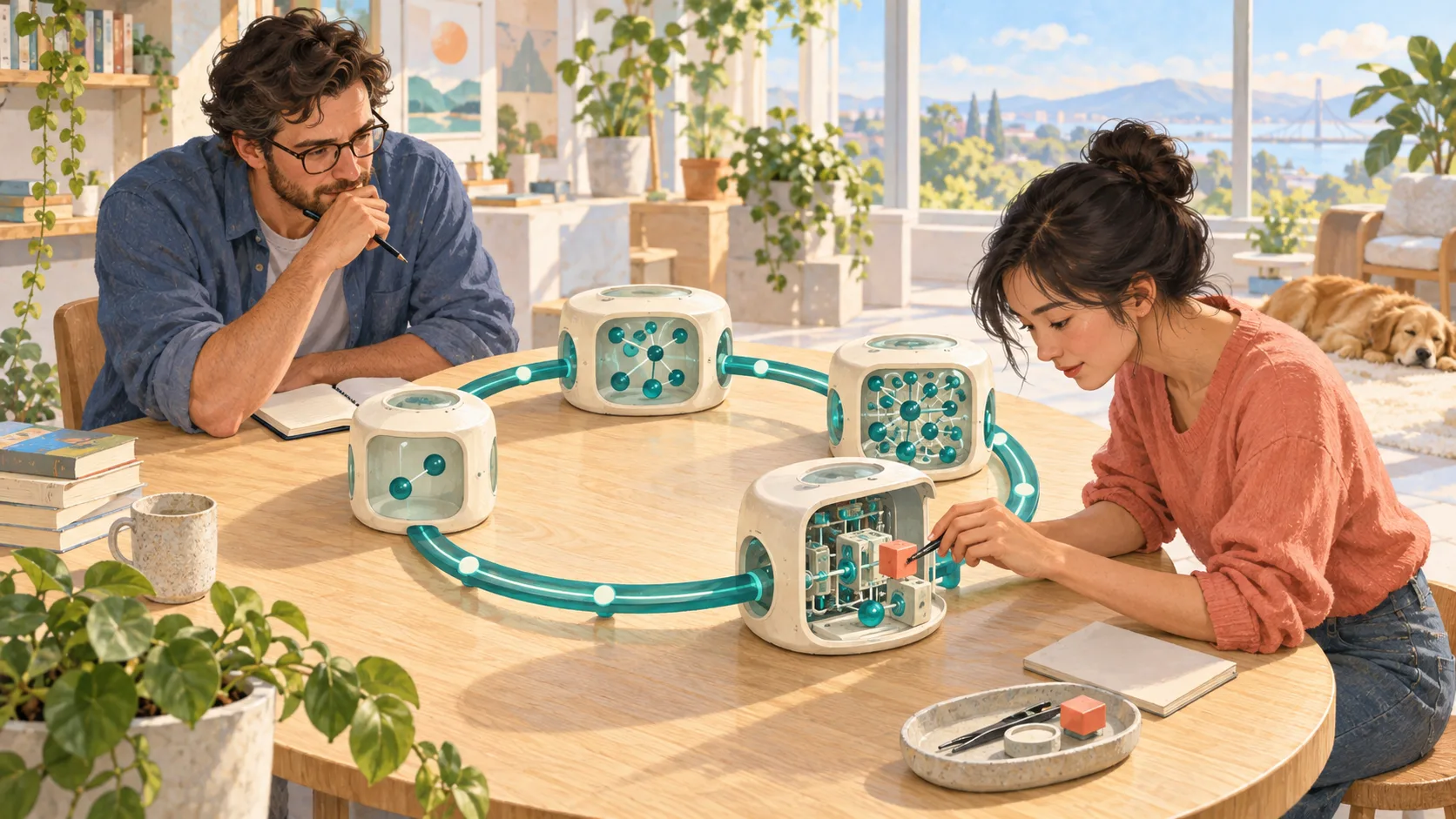
Cover and garden images are AI-generated illustrations of the learning environments imagined in this article.
Continue in