AI Innovations in Healthcare
Clinical AI, drug discovery, and brain interfaces: distinguish workflow benefits, research results, and regulatory milestones.
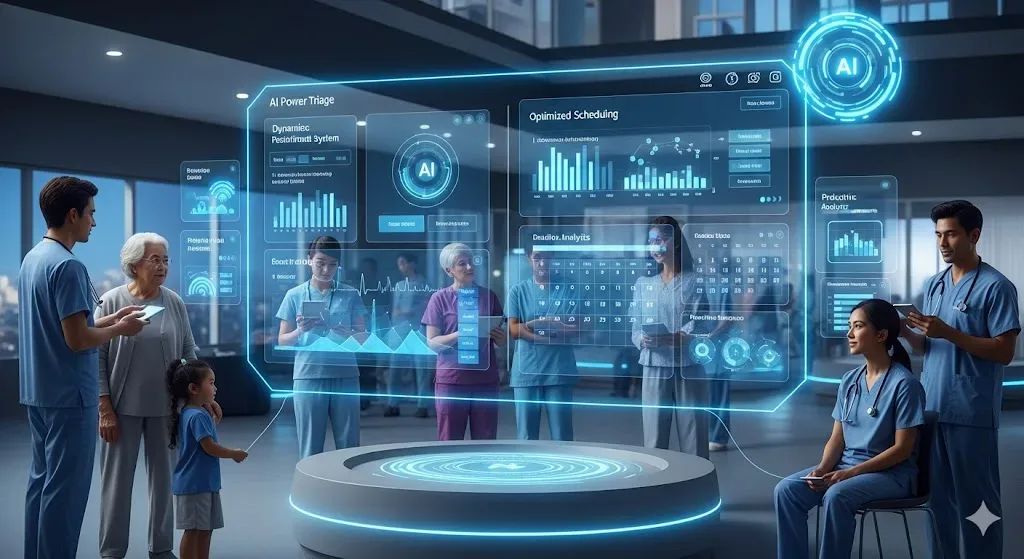
The healthcare applications of AI that matter most to me connect a technical capability to something a person can do: spend more attention on a patient, investigate a disease, or communicate after losing speech. Those are different goals, and they need different kinds of evidence.
Less paperwork is a workflow goal
A documentation assistant can turn a consultation into a draft note. That may reduce administrative work, but the note still needs review for omissions, incorrect attribution, and invented details. Time saved, clinician experience, documentation accuracy, and patient outcomes are separate endpoints.
For a deployment report, I would want the number of clinicians and encounters, the measurement period, the comparison workflow, and how time savings were estimated. I would also want to know whether the measured benefit persists after review time is included. The earlier unsourced 15,000-hour anecdote is removed; it cannot carry that argument without a study or methods note.
The same distinction applies to triage and scheduling. Booking an appointment is not the same as determining the urgency of symptoms. A triage evaluation needs to examine missed emergencies and unnecessary escalation, not just successful conversations.
A clinical signal, with a causal limit
The 2022 prospective, multisite TREWS study examined provider interaction with a deployed sepsis warning system. Among the study’s sepsis patients, confirmation of an alert within three hours was associated with an adjusted 3.3-percentage-point reduction in in-hospital mortality, or 18.7% relative reduction, compared with later or absent confirmation within that window. This was an observational comparison, not randomized proof that the algorithm alone caused the difference. Clinician response and patient differences matter. Nature Medicine study abstract and methods.
That is more informative than saying an AI colleague reduced mortality by 20%. It identifies the workflow, comparison, endpoint, and uncertainty. The earlier statement that alerts arrive six hours before symptoms is not retained.
Restoring communication: one participant is still meaningful
In a 2024 study reported by UC Davis, an investigational brain-computer interface helped one participant with ALS translate attempted speech into text and synthesized speech. With a 125,000-word vocabulary, reported word accuracy reached 90.2% after additional training and 97.5% after further data collection. The report covers 84 sessions over 32 weeks. These are different training stages, not interchangeable results. UC Davis’s research account, linking the NEJM paper.
The human consequence is substantial. The evidentiary limit is also clear: one participant does not establish performance across patients, long-term implant safety, or routine clinical availability. Decoding attempted speech is not unrestricted mind reading. Other device demonstrations should be assessed on their own participants, tasks, follow-up, and surgical burdens.
Drug discovery is a sequence of tests
AI can help propose targets, rank molecules, and interpret experimental results. Each step hands a hypothesis to another form of validation. A promising model prediction does not show that a compound reaches its target safely in people.
When reading an announcement, I would locate it on this sequence:
| Milestone | What it can establish | What it does not establish by itself |
|---|---|---|
| Computational prediction | A candidate worth testing under the model’s assumptions | Biological activity or clinical benefit |
| Laboratory or animal experiment | Evidence in that experimental system | Safety and efficacy in humans |
| Early human study | Initial safety, dosing, or preliminary signals, depending on design | Broad effectiveness or approval |
| Controlled efficacy study | Evidence for specified endpoints and population | Benefit for every use or patient |
| Regulatory authorization | Permission for a defined use under a particular framework | Unlimited safety or effectiveness |
This is a simplified map; study designs and pathways vary. The FDA’s drug-development overview explains the progression. Calling a discovery “AI-designed” should also specify which parts AI contributed: target selection, molecule design, screening, or trial operations.
A designation is not market authorization
The FDA Breakthrough Devices Program supports development and review of qualifying devices. A designation is not a marketing authorization and should not be reported as confirmation that a device works for routine care. A product must still meet the applicable evidentiary and regulatory requirements. FDA program explanation.
Funding, trial enrollment plans, and commercial partnerships show activity. They are not patient outcomes. Keeping these categories distinct makes a landscape article more useful without diminishing promising research.
What I would watch next
I would look for independently assessed outcomes, results across patient groups and sites, meaningful follow-up, and a clear account of failures. A system also needs consent and data handling appropriate to its use, a responsible clinical team, and a route for patients to correct errors or obtain human review.
What excites me is the possibility of restoring time and capability. The evidence should tell us which capability was restored, for whom, and under what conditions. That makes the promise concrete enough to evaluate.
Continue in