Context Engineering
typedef's data context layer — a graph of relationships over the data estate, computed once on commit, with provenance and confidence on the edges.
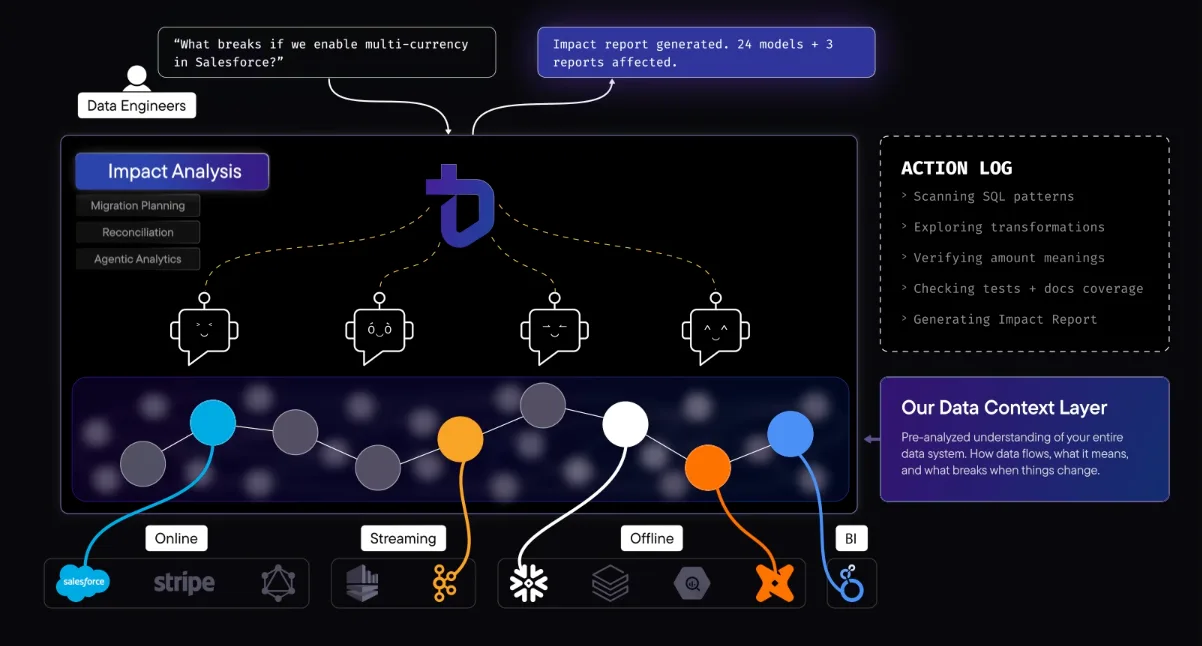
Valid SQL is not enough. An agent also needs to know what the data means, and which parts of it relate to which.
The short version
- The semantic context gap: why valid SQL isn't enough when nothing tells the agent what the data means
- The data context layer pattern — a graph of relationships over the data estate, computed once on commit, with provenance and confidence on edges
- Seven design principles that generalize beyond data engineering, from deterministic-first to owning the agent's tool surface
Traversal Beats Prompt Stuffing: Graphs for Data Relationships
typedef (typedef.ai, fenic, speakers @yoni_michael and Brandon Callender) addressed the semantic context gap: data storage is segmented, and nothing tells the agent what the data means. Valid SQL is not enough — the agent needs to know that fresh data was just loaded (so context changed) and which data assets relate to which. Their answer is a data context layer: a graph of relationships over the data estate, with principles that generalize well beyond data engineering:
- Deterministic first — LLM only where it earns its keep (parse logic and relationships deterministically)
- Computed once, on commit — not re-derived per query
- Edges carry provenance and confidence
- Traversal beats SQL joins — and traversal beats prompt/context stuffing: one traversal, not a prompt dump
- Store evidence, not conclusions
- Own the agent's tool surface — a curated tool set versus a buffet of generic MCPs
- Evals, evals, evals — benchmarked against ADE-Bench
A wry closing observation from the workshop (agent-context-workshop): sometimes "grep works better" — the cheapest deterministic retrieval should always be tried before the clever one, which is the deterministic-first principle eating its own dog food.
Sometimes "grep works better." — typedef's agent-context workshop
Try this next
- Before adding a clever retrieval layer, try the cheapest deterministic one — parse logic and relationships deterministically and use the LLM only where it earns its keep
- Build (or buy) a context layer that computes relationships once on commit, carries provenance and confidence on edges, and lets the agent traverse rather than stuff prompts
- Curate the agent's tool surface on AgentCore Gateway — a small, task-scoped tool set rather than a buffet of generic MCPs — and benchmark it with evals (e.g. ADE-Bench for data tasks)
Continue in