The Gentle Singularity: An Imagined Timeline to 2030
A speculative scenario inspired by Sam Altman’s essay, with imagined milestones and explicit dependencies.
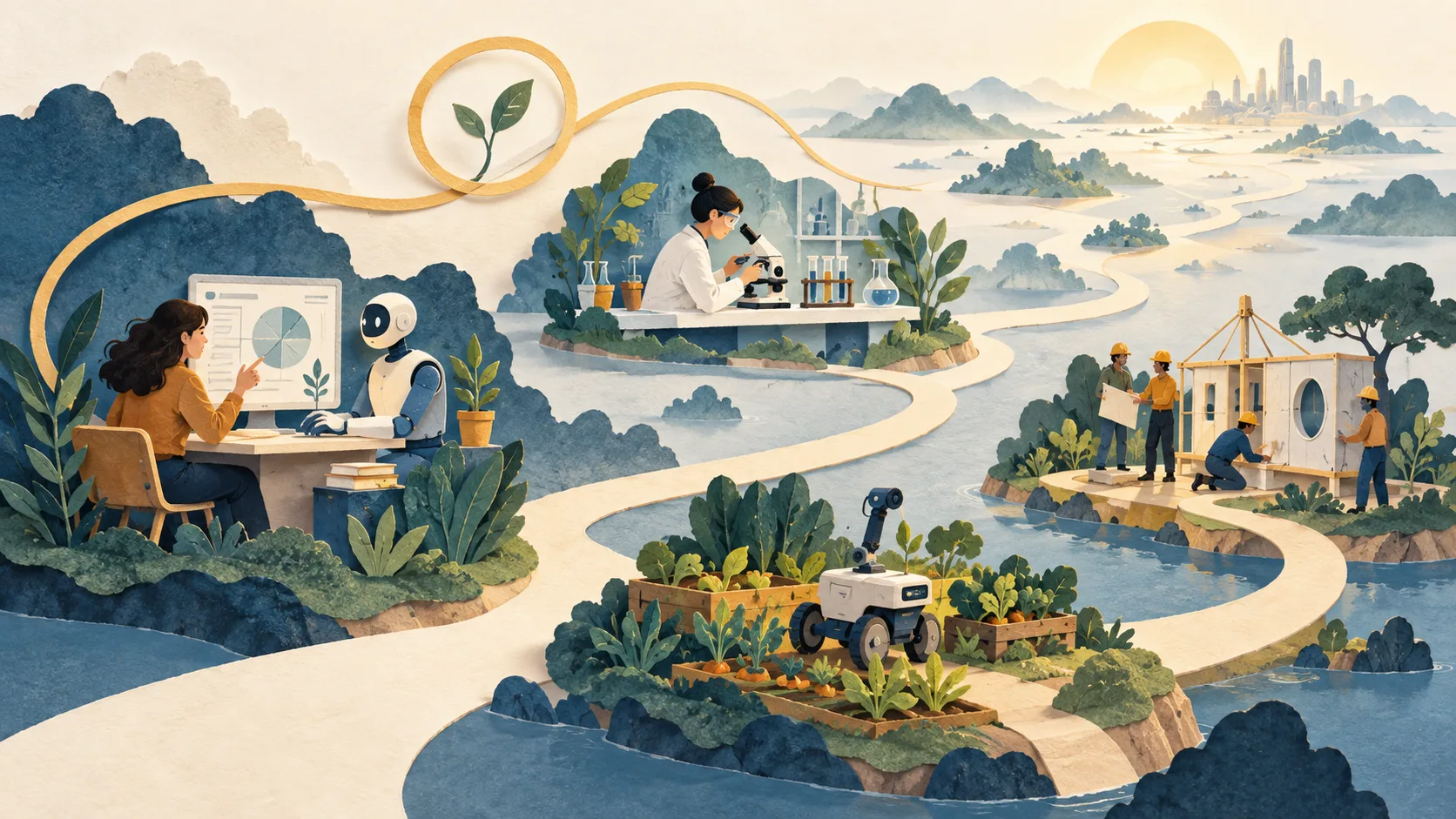
Sam Altman’s June 2025 essay, The Gentle Singularity, imagines AI tools accelerating the development of better tools. That compounding possibility is what interests me.
The timeline below is my imagined scenario, inspired by that essay. It is not a report of events, a validated forecast, or a claim that Altman predicted each of these milestones. The years are narrative markers, not deadlines.
2025: From assistance toward delegation
My starting point is the shift toward asking coding tools to carry out sequences of tasks. The extrapolation is that developers could spend more time setting goals and reviewing work. Reliable verification remains a condition, not an automatic consequence of autonomy.
2026: More help with scientific investigation
In this scenario, agents could help compare papers, propose experiments, and analyze results. A useful hypothesis would still need independent experimental validation. The earlier protein breakthrough example was unsubstantiated and is removed.
2027: More capable robotics workflows
AI could make some robotic tasks easier to specify and adapt. Real-world deployment would still depend on hardware, bounded operating conditions, safety engineering, and maintenance. Model-guided instructions alone would not make a robot safe.
2028: Robotics becomes more personal
Imagine hobbyists building small robots for garden or household tasks. Affordable hardware, dependable perception, and support would determine how far that spreads. This is a possibility I find appealing, not a documented adoption milestone.
2029: AI helps build infrastructure
Planning and coordination tools could contribute to construction and manufacturing. Permits, materials, energy, skilled labor, and physical execution would still constrain how quickly capacity grows. Autonomous control of an entire supply chain is a much stronger assumption.
2030: A stronger feedback loop?
If these improvements reinforce one another, better tools could help create the next generation of tools. But intelligence and energy would not become unlimited merely because a loop exists. Evaluation quality, resource costs, and institutional choices could slow or interrupt it.
The possibility I want to explore is more human capability: more people able to investigate, design, and build. Whether this imagined sequence happens depends on what we can actually verify and sustain.